FREE GUIDE: All-Purpose Tips For Conflict
Dig deeper in the “Idiots Are Everywhere Workshop” starting 9/21

Hey there! I hope you had a wonderful Labor Day Weekend. Perhaps the end of summer has you edgy at the thought of dealing with… them.
You know: the people you could mostly avoid because it was summer and folks were traveling, but now that we’re back in our routines you have to put up with… them.
Don’t panic! I’ve got something for you.
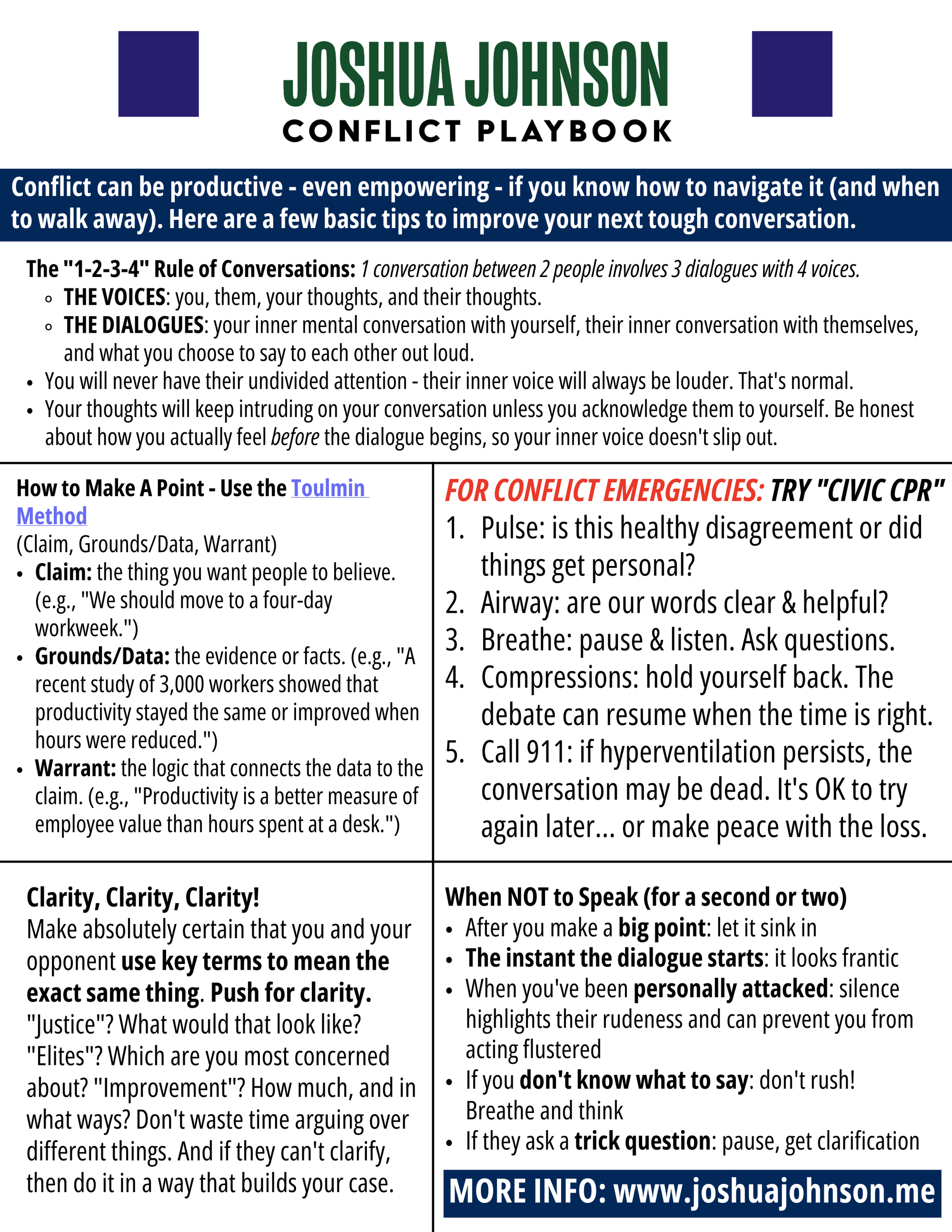
This free guide contains my all-purpose tips for handling conflict in conversations. Give them a try, and let me know in the comments. And please, share this guide with someone who would benefit from it.
The "1-2-3-4" Rule of Conversations
1 conversation between 2 people involves 3 dialogues with 4 voices.
- THE VOICES: you, them, your thoughts, and their thoughts.
- THE DIALOGUES: your inner mental conversation with yourself, their inner conversation with themselves, and what you choose to say to each other out loud.
You will never have their undivided attention - their inner voice will always be louder. That's normal. Your thoughts will keep intruding on your conversation unless you acknowledge them to yourself. Be honest about how you actually feel before the dialogue begins, so your inner voice doesn't slip out.
How to Make A Point
Use the Toulmin Method (Claim, Grounds/Data, Warrant)
- Claim: the thing you want people to believe. (e.g., "We should move to a four-day workweek.")
- Grounds/Data: the evidence or facts. (e.g., "A recent study of 3,000 workers showed that productivity stayed the same or improved when hours were reduced.")
- Warrant: the logic that connects the data to the claim. (e.g., "Productivity is a better measure of employee value than hours spent at a desk.")
Clarity, Clarity, Clarity!
Make absolutely certain that you and your opponent use key terms to mean the exact same thing. Push for clarity. "Justice"? What would that look like? "Elites"? Which are you most concerned about? "Improvement"? How much, and in what ways? Don't waste time arguing over different things. And if they can't clarify, then do it in a way that builds your case.
When NOT to Speak (for a second or two)
- After you make a big point: let it sink in
- The instant the dialogue starts: it looks frantic
- When you've been personally attacked: silence highlights their rudeness and can prevent you from acting flustered
- If you don't know what to say: don't rush! Breathe and think
- If they ask a trick question: pause, get clarification
FOR CONFLICT EMERGENCIES: TRY "CIVIC CPR"
- Pulse: is this healthy disagreement or did things get personal?
- Airway: are our words clear & helpful?
- Breathe: pause & listen. Ask questions.
- Compressions: hold yourself back. The debate can resume when the time is right.
- Call 911: if hyperventilation persists, the conversation may be dead. It's OK to try again later... or make peace with the loss.